

Thinking Process Test: How 1000 & 2000 ELO Calculate Differently
October 16, 2026 2026-10-16 17:09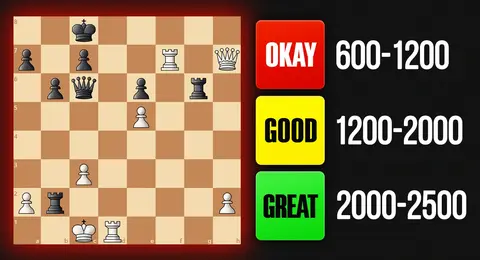
Thinking Process Test: How 1000 & 2000 ELO Calculate Differently
Thinking Process Test: How 1000 & 2000 ELO Calculate Differently
What separates a 600 ELO chess player from someone rated 2000 or higher?
You might think the answer is better opening knowledge, deeper calculation, or stronger tactical skills.
But one of the biggest differences is something much more fundamental: how they think during a chess game.
I gave the same chess puzzle to players at different rating levels, from around 600 ELO all the way to 2000+ to test their thinking process, and the differences were fascinating.
This position was taken from a game between Viktor Korchnoi and Vitaly Chekhover. Korchnoi actually came very close to becoming World Chess Champion.
How Chess Thinking Changes With Rating
At lower rating levels, players often struggle to decide where to begin. Should they calculate checks, capture material, or search for a hidden tactical combination?
As players become stronger, their thinking becomes much more organized.
Instead of calculating random variations, they evaluate the position, identify promising candidate moves, and focus on the lines that actually matter.
Most importantly, they don’t just calculate the moves they want their opponent to play. They actively search for the opponent’s strongest defense.
How to Improve Your Chess Calculation
In this lesson, I’ll show you how to:
- Evaluate a chess position before calculating.
- Identify forcing moves and promising candidate moves.
- Avoid wasting time on irrelevant variations.
- Test your ideas against your opponent’s strongest replies.
- Develop a clearer, more systematic chess thinking process.
The puzzle also contains a surprisingly unusual defensive idea that challenges even stronger players.
Thinking Process Test Video Lesson
Before watching my explanation, pause the video and try solving the position yourself.
Don’t focus only on finding the best move. Pay attention to how you arrive at your answer.
Then compare your thinking process with players at different rating levels.
You may discover that improving your chess rating isn’t always about calculating more moves. Sometimes, the biggest breakthrough comes from learning what to calculate, when to calculate it, and how to evaluate the results.
Below, you can find the puzzle’s solution (with the full game) shown in the video:

Pair these tips with pattern recognition. Browse the Chess Tactics Lesson Guide. Access lessons on tactical motifs, patterns and combinations across all phases of the game.
Many players can solve difficult puzzles and have puzzle ratings way higher than their respective game ratings. Often they get frustrated when they’re puzzle ratings go up but their chess rating remain stagnant and they don’t why. This is usually because they use a different thinking process when playing than when solving puzzles.
If this is your problem, then there’s a simple solution. You need to get a structured program that can help you develop a thinking system similar to the one you use when solving puzzles. At RCA, we have assembled such courses into a bundle that will help you achieve this goal and reach 2000 ELO. Check out our Boost Your ELO to 2000 Bundle.

Individually, the courses included here are valued at $486. But if you purchase them as a course bundle, then you can get them for only $197. That’s nearly a 60% discount!!


