A Simple Framework to Spot Chess Tactics in Real Games
November 25, 2026 2026-11-25 8:27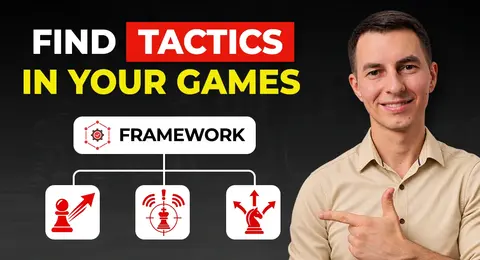
A Simple Framework to Spot Chess Tactics in Real Games
A Simple Framework to Spot Chess Tactics in Real Games
Have you ever solved hundreds of chess puzzles to spot different tactics, only to miss a simple combination in your next game?
This is one of the most frustrating problems for improving chess players.
You can recognize forks, pins, discovered attacks, and other tactical patterns when solving puzzles. But during actual games, those same opportunities often go unnoticed.
Why does this happen?
The answer is surprisingly simple: when you’re solving a chess puzzle, you already know there’s a tactic to find.
In a real game, nobody tells you when a tactical opportunity exists.
That’s why improving your tactical awareness requires more than simply solving additional puzzles. You need a reliable thinking process that helps you recognize when to start searching for tactics.
In this lesson, I’ll explain a simple framework I use to identify tactical opportunities and find stronger attacking moves.
Why Chess Players Fail to Spot Tactics in Real Games
When you open a chess puzzle, you immediately begin searching for forcing moves.
You examine checks, captures, sacrifices, and possible combinations because you know there’s something special hidden in the position.
But during a real chess game, you must decide for yourself whether the position contains a tactical opportunity.
Without a clear method, it’s easy to make an ordinary move and overlook a winning combination.
The solution is to develop a framework that tells you when and where to look for tactics.
Step 1: Look for Forward Pressure
The first step in my framework is something I call forward pressure.
Instead of immediately searching through countless variations, examine your opponent’s half of the board.
Ask yourself:
“How can I move forward and create a threat?”
This question encourages you to look for active possibilities rather than automatically choosing quiet or defensive moves.
By identifying opportunities to create pressure, you can begin recognizing positions where tactical combinations might exist.
Step 2: Recognize Important Tactical Signals
Certain positional features make tactical opportunities more likely.
For example, an exposed king can become vulnerable to forcing moves, while loose or undefended pieces can create opportunities for tactical combinations.
A lack of defenders is another important warning sign.
When several of these factors appear together, you should become particularly alert.
The key signals to watch for include:
- An exposed or poorly protected king
- Loose or undefended pieces
- Important squares with insufficient defenders
- Opportunities to create immediate threats
These features don’t guarantee that a winning combination exists, but they tell you when a deeper tactical search may be worthwhile.
Step 3: Calculate Checks, Captures, and Threats
Once you’ve identified promising attacking signals, it’s time to calculate.
Start by examining forcing moves:
Checks: Can you attack the opponent’s king and force a response?
Captures: Are there exchanges or sacrifices that could change the position in your favor?
Threats: Can you create a serious problem that your opponent must address?
This approach helps you concentrate on meaningful variations instead of calculating random moves.
How to Improve Your Tactical Awareness
If you want to become better at spotting tactics, don’t focus exclusively on solving increasingly difficult chess puzzles.
Practice recognizing the situations in which tactics are likely to appear.
During your games, look for forward pressure, identify weaknesses in your opponent’s position, and examine forcing moves when the attacking signals are present.
Of course, every promising idea must still be checked against your opponent’s strongest response.
The goal is to turn tactical awareness from guesswork into a systematic chess thinking process.
Once you develop this habit, you’ll be better equipped to recognize tactical opportunities in your actual games — not just when solving puzzles.
Below, you can find the puzzles and examples shown in the video:

Learn to spot more patterns with the help of our Chess Tactics Lesson Guide. Access lessons on tactical motifs, patterns and combinations across all phases of the game.
If you like to get a structured program that can help bring you to the level of 2000 Elo and beyond, we have assembled courses into a bundle that will help you achieve this goal. Check out our Boost Your ELO to 2000 Bundle.

Individually, the courses included here are valued at $486. But if you purchase them as a course bundle, then you can get them for only $197. That’s nearly a 60% discount!!