How to Find a Good Chess Coach?
August 29, 2022 2025-06-14 2:01
How to Find a Good Chess Coach?
How to Find a Good Chess Coach?

Do you know how to find a chess coach? A good chess coach? This is a very important question. Let’s be realistic: without a good coach, your chances of becoming a titled player are quite miserable. ☹️
“To know the road ahead, ask those coming back” – says a wise Chinese proverb.
Of course, you can try to discover everything by yourself: read books, play games, analyze your mistakes and work on their elimination, etc. Perhaps sooner or later you will come to the right decision.
But chess is a competition. Your opponents – who are taught by good coaches, and whose training is more effective – will beat you.
This turns us back to the 1st question: How to find a good chess coach?
I’ve been struggling with this question all the time since I was an active chess player. That’s one of the reasons why I decided to become a chess coach by myself 🙂
In 2004 I finished a Sports School in my region and since that time started my coaching practice.
All in all, I have quite huge experience both as a chess student and as a teacher. So, let me give you some hints.
A Private Chess Coach Should Perform the Following Things for You:

1. Analyze your games and detect what you need to work on.
2. Develop your training plan.
3. Make online or real lessons.
4. Give you home tasks.
5. Answer your arising questions via e-mail.
6. Check your last home task, and provide you feedback on your work.
7. Prepare the next online/real lesson based on your training plan and the current needs (that have been detected during items 1 and 5-6).
8. Think about your overall progress; make necessary corrections in your training plan.
9. Plan your participation in tournaments.
10. Keep track of the current situation in chess (read chess news, observe main tournaments, notice new tendencies, popular openings, etc). A private chess coach should perform all these tasks regularly, even if you have only 1 chess class in a week!
By using the above list of items, it will be easier for you to evaluate a certain coach, and to decide if he/she is a suitable one for you.
Nowadays, many websites offer you the services of various chess coaches. Recently I visited one such website, and read coaches’ descriptions. Some of them write something like “I am a very popular coach and I have 50+ private students”. I don’t know whether to laugh or cry at this…
Take a look at our list above. Is that possible to perform it for 50 students? Of course NOT!
In fact “50+ students” means that this person teaches all his students extremely superficially, and he spits upon them all! Does he think this is his positive side😨?
Let’s move on to the next advice:
A Private Chess Coach Should Be a Coach.

It’s not a joke 🙂
A strong player (IM or GM) can show you some opening lines and can play with you, BUT he can’t be your teacher.
Is he going to perform the coach’s duties (see our list above)? Of course not! He is not even aware of these duties…
Can a GM understand your current problems and needs? Well, he was in your situation, However, maybe it was 50 years ago!!
Another example. A chess coach must collect useful games/positions that are suitable for training a certain topic. Does a chess player have such collections for every important topic? No! He simply doesn’t need it.
There is a HUGE difference between being a chess player and being a chess teacher. It requires different skills and knowledge. That’s why quite a lot of “coaches”, unfortunately, have no idea how to teach.
So, when you are looking for a private coach – select a coach.
We’ve been talking about chess coaches, and I hope you got some insights about it. Now let’s take a look at a STUDENT. There’s 1 important thing I’d like to emphasize here.
A student usually does NOT know what he/she needs.
“To know the road ahead, ask those coming back”.
How Can You Know What You Need for Advancing to the Next Level if You Have Never Been on That Next Level?

You enjoy making those things which you perform well. And you dislike things that you are failing in. This is normal and natural for all chess players.
If you dislike defense, you don’t know this topic well, and this topic seems hard and uncomfortable for you – you’ll never master it. So, here should come a coach and force you to do what you don’t want to do. This will eliminate your weakness, will bring you nice victories, and… you’ll start enjoying a defense! 🙂
A student usually does NOT know what he/she needs.
This is reality. You can admit it and go forward or stuck with your delusions. The choice is yours.
I Recommend that You Find a Good Coach and then Rely on Him.

Otherwise, you’ll appear in the same situation as most of the other chess players. Here’s the most typical scenario: a coach who doesn’t know how to teach satisfies the wishes of a student who doesn’t know what he needs.
Sadly, this is the most precise description of most chess lessons out there. That’s why the majority of players suffer from little and unstable progress.
However, now you have a better alternative! Follow the advice from this article and be ahead of the crowd!
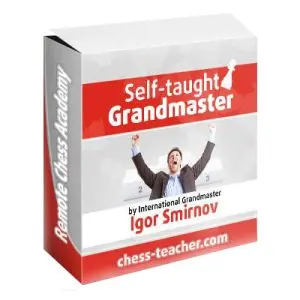
If you don’t have good coaches in your area (or if they are too expensive for you) – you may use my course “Self-taught Grandmaster”. It will substitute your coach and will allow you to organize an effective self-training process.