Pin and Skewer: What’s the Difference?
September 16, 2024 2026-01-01 9:56
Pin and Skewer: What’s the Difference?
Pin and Skewer: What’s the Difference?
In chess, two of the most powerful tactical tools are the “pin” and the “skewer.” Both tactics involve long-range pieces like bishops, rooks and queens, and both work by attacking two pieces at once along the same line.
While these tactics are related, they function in opposite ways. Understanding the differences between a pin and a skewer, as well as the various types of pins, can give you an upper hand in your chess games.
What is a Pin?
A pin occurs when a piece is attacks one piece directly and another piece behind it indirectly. The pinned piece cannot move without exposing a more valuable piece behind it. Pins are especially effective because they immobilize the attacked piece, allowing the attacker to build pressure or exploit other weaknesses on the board.
Types of Pins
Absolute Pin: In an absolute pin, the pinned piece cannot legally move. Because doing so would expose the king to a direct attack (check), which is not allowed in chess. For example, if a black bishop pins a white knight to the white king. The knight is absolutely pinned and cannot move.
Relative Pin: A relative pin occurs when a less valuable piece is pinned to a more valuable piece (like a queen or rook) but is legally allowed to move. The pinned piece may still be reluctant to move, as doing so would lead to the loss of the higher-value piece behind it. For instance, a white bishop pinning a black knight to a black queen is a relative pin.
Situational Pin: A situational pin occurs when a piece is pinned in a specific scenario where moving the pinned piece would lead to a tactical disaster. This could be a checkmate or loss of material.
These pins often appear in complex middlegame positions or during tactical combinations. While technically the piece may not be pinned in the absolute or relative sense, moving it would create serious problems.
Cross Pin: A cross pin happens when a piece is pinned in two different directions simultaneously. Let’s look at a puzzle to see this in action.
Puzzle With Pins
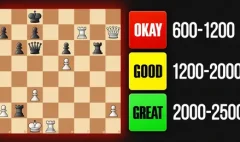
The situation looks bad for White but it is his turn. Can you find a solution?
After Rxe6 Rxe6, the rook just renews the pin. But White can play a Decoy move b6+. If Black plays Ka8 or Kb8, White can just give a check with Rh8+ which will force Black to block with the Queen and checkmate will be inevitable.
Black’s best move is to take the pawn. If he takes the pawn using the rook, the Queen will be left hanging. So Black takes the pawn with Kxb6. Now comes White the cross pin: RH6
Learn more how to deal with pins in this video.
What is a Skewer?
A skewer is the opposite of a pin. In a skewer, a piece attacks a more valuable piece first. When it moves, it exposes a less valuable piece. Unlike a pin, where the front piece is often unable or unwilling to move, in a skewer, the player is usually forced to move the higher-value piece, exposing the lower-value piece to capture.
For example, imagine a white queen on the a1 square skewering a black queen on e5 and a black rook on h8. The black queen must move out of the way, and after it does, the white queen can capture the rook.
Pin and Skewer: What’s the Difference?
- Pin: A piece in front of a more valuable piece is attacked; it cannot or should not move because the piece behind it would be captured or checked.
- Skewer: A more valuable piece is attacked. Once it moves, a less valuable piece behind it is exposed for capture.
See other chess tactics in this article.
Conclusion
Both the pin and the skewer are highly effective tactics in chess. They both target two pieces at once, but they differ in their application. Pins immobilize or restrict the front piece, while skewers force the more valuable piece to move, exposing the piece behind it. By recognizing and employing these tactics, you’ll be able to turn difficult situations to your advantage and increase your chances of victory.

Browse the Chess Tactics Lesson Guide. Access lessons on tactical motifs, patterns and combinations across all phases of the game.